Showing posts with label china. Show all posts

Saturday, March 9, 2013

mqff is upon us! prepare for queer cinema!

The Melbourne Queer Film Festival starts next week, and as always I'm super excited! I missed out on the Festival last year (because China), and I'm really looking forward to this year's festival.

I volunteer every year, which is something I recommend for anyone who is in to films, is in to queer films, or wants to support their queer community. It's a great festival, everyone is always really lovely and there's a great feeling around it.

Also, this year, there are vegan lollies available for sale! Which is pretty awesome, please feel free to thank your local vegan for the idea (me) and everyone at MQFF who let me suggest it and then just Did It. I love when people accomodate dietary requirements, I hope there's no gluten in the lollies hmm. And there's an app for iPhone and Android, and most of the movies screen at ACMI which as you know (Melbourne) is one of the best cinemas and spaces ever.

Here is my short list, in screening order:

When Hainan Meets Teochew (当海南遇上潮州) (Saturday 16 March, 16:00)

When Hainan Meets Teochew tells a unique story about love between a butch and a femme woman. The two meet in the most unusual circumstances (involving a falling bra), become enemies in the most unpredictable situation and become friends in the most unforgettable manner. Just as they gradually develop feelings for each other, Hainan’s ex-girlfriend appears and puts their relationship under the most challenging test. The ensuing love triangle results in much misunderstanding and hilarity. What will become of Hainan and Teochew’s romance, and who is the owner of the falling bra?


Oz Docs (Monday 18 March, 18:00)

This is a series of Australian documentaries, including 'The La La Road' on Chinese lesbians, and the Aquaporko Documentary, featuring a whole lot of awesome, fat, queer ladies of my acquaintance.

Cockpit (Thursday 21 March, 18:30)

Mrs. Doubtfire meets Tootsie, meets Some Like it Hot - 10,000m up, in this over-the-top comedy of mistaken identities from Sweden. After losing his job as an airline pilot when his company downsizes, Valle is thrown out by his materialistic wife, who takes the kids with her and immediately begins a new relationship with a wealthy elderly man. After countless knock backs by airlines, he hears that Silver airlines are looking for a female captain. In desperation, and with little in the way of a plan, Valle dons a pair of high heels, borrows his staunchly feminist and queer friendly sister’s identity and transforms himself into attractive Maria and wins himself a pilot’s job. The plan begins to unravel when his lesbian airline colleague Cecilia starts to fall for him/her, and a narrowly averted plane crash, lands Maria all over the news.


Queens! Destiny of Dance (Friday 22 March, 20:30)

Guru Amma presides over a community of hijras (male to female transgenders) inside a huge palace, with love and severity in equal measure. The apple of her eye is the talented Mukta who is the best dancer among them and also the potential next leader of the community. Mukta adores Guru Amma with all her heart, to the point of worshipping her. One day, a beautiful young girl turns up at their door without any explanation. Awed by her beauty, Amma takes the mysterious girl under her wings and names her Nandini.

Soon, Nandini becomes the centre of attraction for the other hijras and for Amma as well, thereby sidelining Mukta. Mukta’s jealousy soon turns to paranoia about Nandini, and Mukta leaves the community after threatening Amma. But Mukta soon realises that she will never be taken back into her house or the community. Determined to set things right, Mukta returns to Amma and the community, but behaves kindly towards Nandini this time around, until enough is enough and events unfold leading to a shocking climax.

True to the essence of Bollywood films, Queens! is chock full of colourful characters, and fantastic dance scenes.


Strange Frame: Love and Sax (Saturday 23 March, 14:00)

The first lesbian, science fiction, rock ‘n’ roll animated film is here! Hold on tight as we head off into the 29th Century.

200 years after the human race has left a decimated Earth behind, life on Ganymede, one of Saturn’s moons, is a world of space pirates, indentured slaves and genetic mutations. Parker, a saxophonist, meets a gutsy singer, Naia, who’s a ‘debt slave’, and the two quickly fall in love and form a band. Gaining cult notoriety, the band catches the eye of the authorities, and Naia is recaptured. As Parker begins a desperate search for her love, Naia is repackaged by ‘the man’ as a generic rock star and achieves immense fame. Will Naia be saved before her soul is forever destroyed?


(quotes are from the mqff programme)

I always keep my short list short, because I burn out fast during festivals, but others I wouldn't mind seeing eventually are:
Gayby
My Best Day
The Mermaids
Speechless (无言)

Monday, October 29, 2012

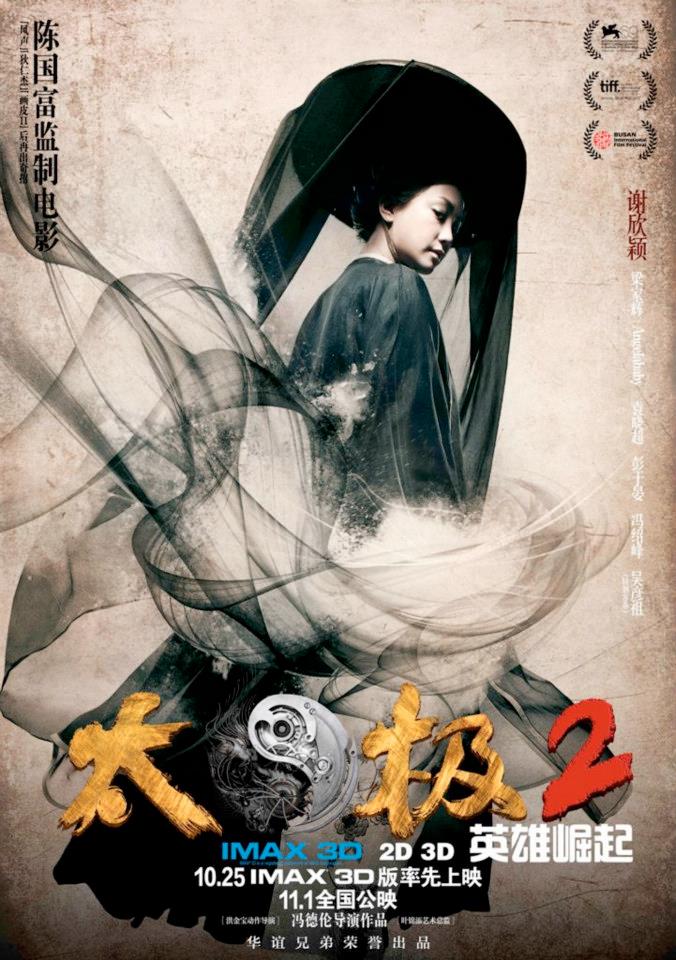
movie review: tai chi hero / 太极2


My short review on twitter immediately after seeing Tai Chi Hero:
[text of tweet: love flying machines & kung fu machines; sideeye at sudden & unexpected sideline of ladies; enjoyed the humour.]
The longer review (some spoilers):

Tai Chi Hero follows immediately on from Tai Chi 0, and has been released in China (and in Australia) with only a month between. It's easy to view them as one long movie, but it's easy to see where the original rumours of a trilogy would have come from. It's a duology with an epic story to tell, and just not enough time.

In Tai Chi 0, Yang Lu Chan ("the freak") comes to Chen Village to learn the Chen family style of Kung Fu. Lu Chan has been born with a natural advantage, the "Three Blossoms Horn" which both gives him awesome powers and is slowly killing him, hence his need to learn the more even Chen family style. The problem is that Chen family style is only taught to members of the Chen family, and Lu Chan is desperate enough to try anything to learn this style.

Tai Chi 0 features lots of fun action, videogame style sequencing and introductions, and lots of elements that I loved (including great machines and action sequences), as well as some awesome characters such as Yu Niang, who is not only the village apothecary but also completely stone fierce; brother Tofu; and the overly dramatic Fang Zijing, a family member with the wrong name who has never been allowed to learn the Chen family style.

In Tai Chi Hero, we are introduced to the remaining characters, some who have been given elevated importance in the trailer and some who weren't really introduced at all. The Inventor and the Silent Wife turn up, and I really hope that the Silent Wife's parts were originally there but later cut because otherwise what we have is a mysterious sidelining of the ladies, after they were all so awesome in the previous instalment. Yu Niang, who was so amazing in Tai Chi 0, and becomes Lu Chan's teacher in this instalment, is later resigned to standing on the sidelines as Lu Chan battles to prove that they are truly from the Chen family. This is obviously done for story purposes - it is, after all, the story of how Lu Chan becomes one with the yin and yang and with himself, therefore it must be he who demonstrates the style for the story - but Yu Niang, as daughter of the Chen Grandmaster, is surely the more logical demonstrator here? And the Silent Wife has so much potential, does some excellent kung fu, and then runs around looking sad and being threatened with torture. As this follows on from British agent Claire Heathrow's death in Tai Chi 0, which motivates Fang Zijing to become Truly Evil, it is unfortunate.

The switches between English and Mandarin are fun but sadly lacking. Mandy Lieu, as Claire Heathrow, is great in Mandarin but not so much in English. Peter Stormare turns up as another agent of the British East India Company and chews the scenery in both English and Mandarin. Eddie Peng (as Fang Zijing) is dramatic in English and unsympathetic in Mandarin.

It's not all criticisms. In fact, it's barely any criticisms, really, I criticise because I care. Tai Chi Hero continues to be a great (if heavy-handed) look at the impact of Western influence and modernisation in China at the turn of the century, and how that conflicted and contrasted with the desire to keep things as they are, for whatever reason and by whatever means necessary. It's a look at government corruption and the interpretation of history. I loved big brother, the inventor, who wanted to revolutionise China and his family by taking western machinery and ideas and developing it to take advantage of their best assets - in the Chen family's case, by making their kung fu even better. The revelation of his kung fu-aiding machine vest was probably the greatest moment of the film for me, a commentary on modernisation and adaptability and family and tradition and being Chinese in a five minute sequence. 

I really loved the moment when we found out why the movies are called Tai Chi X; and every moment featuring the Prince.

This instalment also continued with the humour and self-reflection, and I'm sorry to tell you that the translations didn't manage to capture all of the humour in the dialogue, so if you thought it was funny and you don't speak Mandarin, let me assure you that it was actually (intentionally) even more hilarious.

I loved it, I will definitely own this one, and I hope this new-ish trend of Chinese kung-fu steampunk movies continues. I just wish all of them had awesome ladies, is that too much to ask?

Other reviews: Margaret and David review Tai Chi 0 and Margaret interviews Kuo-Fu Chen and Tony Leung Ka-Fai*; Ay-Leen the Peacemaker reviews Tai Chi 0 at Tor; James Marsh at Twitch Films reviews Tai Chi Hero; an article on how it's a return to more traditional WuXia and it's a box office success for doing so (Zh).

*David and Margaret are Australia's favourite movie reviewers. Margaret's earrings have a Facebook page and my favourite Facebook page ever is called "When David Stratton from At the Movies gets shirty about handheld cameras." I love them. A lot.

Friday, September 7, 2012

book review: the fat years by chan koonchung


When I moved back to Australia three weeks ago (!!), the first book I picked up was my copy of The Fat Years (《盛世:中国,2013年》), which I'd left languishing on my bestie's bookshelf. I bought it when it first was translated into English, and then promptly moved to China. As it is a banned book (proclaimed in large print on the cover!), I left the book behind in Australia.
Part satire, part dystopian imaging, part road trip, part political thriller, The Fat Years seeks to establish reasons for erasure, and reasons for acceptance, and whilst it explores these issues it never places the blame in any one area, and never really comes to any conclusion. The government does things; the people do things; the government accepts some actions; the people accept some actions. The structure of the novel means there is a direct opportunity for the government to defend its actions, and defend it it does, in a way that makes such cold (but boring) sense in a Chinese context. It also includes warnings about the path China is taking, at the same time as providing support. It’s a clear indictment of the government system, at the same time as accepting what was done as needful.

Read the full review at my China blog!

citation needed

It was quiet when I finally made it to the path lab, and the tests I was getting meant the phlebotomist could guess I'd been overseas, and ask where I had been. China, I said, and explained that I had been working and living there, and then I waited for the question that is always asked, not only from strangers but from people who I feel should know better.

"Do they have free-thinkers, then?"

 I'm still working on my elevator pitch, but it goes like this:

 Of course they do. I have my issues with the system (I always say this, lest they disregard my opinion as biased or something, though I don't know what would be regarded as biased) but there are writers and artists and scientists and discoveries and awesome things happening every day.


People think that mainland Chinese are still living under the yoke of Mao's wooden farming equipment, wearing their Mao collars and starving, completely unfamiliar with Western media and consumed by their communism. Sure I have a list of issues with China that's longer than I care to actually write down, but there's social media and access to foreign websites and this phlebotomist so clearly thinks that the media we get in Australia tells us everything, that they're not keeping anything out or picking and choosing what stories are spun. There is reporting of a quality higher than Today Tonight in Beijing, I want to say (I rarely do).

The Chinese education system doesn't encourage a deep analysis of media (or referencing and verification, as I can elaborate on at length, with a lot of flailing and waving around of reports I've edited half a dozen times and ask me about the google citation one time), but many people I know work on the assumption that while they're not necessarily being told lies, there's a possibility they're not being told the entire truth. I have a friend who has never lived anywhere other than China, but his first holiday overseas he googled 'Tiananmen Incident' and read and watched everything he could find; and after all of that he went home again.

When I told the story about Kuai (his name is not Kuai, but let us call him that), the phlebotomist paused. "Oh, they can go on holiday?" she asked. Imagine me restraining from throwing my hands up in the air. Going on trips overseas is very encouraged. Domestic tourism is massive but international tourism is growing and growing and growing and if I wanted to change my career to tourism the first thing I would write on any cover letter would be that I speak Mandarin, that I lived in China, that I have connections in China's tourism industry.

Representations of mainland China in English-language media are all dire, post Cultural Revolution gritty stuff. Despite a wealth of Chinese fantasy, science fiction, romance, and comedy being written, the stuff that's translated from Chinese into English and held up as authentic Chinese experiences are those that look at the desolation of the Opening Up of China, or life during the Cultural Revolution. Sometimes there are stories about the materialism of modern China and how it's ruining China (and the world). And let us not forget for a moment that the critiques and summaries of life in China that are given weight are also the ones written by foreigners.

This article at NPR suggests that censorship in China is less about specific issues and more about collective action. Certainly it speaks to my experience - news about the Occupy Movement, for example, was easy to access up until the narrative started to project being about organising against one's own government.

I have a sort of recoil now, a distaste when Westerners ask why Chinese people don't get active about [insert issue here]. Well, I try to say, why don't we? Active in Australia is so specific, characterised as protests and rallies about things we can see, but what brought this up was the pollution in the air in Beijing, and how you just get used to it. She asked, why don't they get active, get something happening about the pollution? I explained that China is developing fast, and there's this idea that in order to catch up with Western, developed countries, China must be like those countries in terms of manufacturing and development, and that the preference, for the most part, was for keeping that manufacturing in-house (this blog post has been at least partially debunked but has some links about this stuff). At least China is taking responsibility for its pollution, I said. Where do you think ours goes, when we import all of our manufactured goods?

Mind blown.

I'm currently reading Gaysia, by Mr Benjamin Law, and I have plans for an extensive review when I'm finished but what stood out for me in the section on China was the concept of self-censorship, and the idea that some censorship was needed, self or otherwise, otherwise there'd be anarchy.

The level of censorship is frustrating and sucks and is all about the national government's obsession with stability, or at least it claims to be. There are ways around it, like hosting websites overseas, getting info from overseas, pointed self-censorship or my very favourite, memes using coded words. The meme in this style that you might of heard of outside of China is the grass-mud horse, both a way of expressing a vulgarity and a political comment. Commentary about China is so obsessed with free speech but often people don't really know what that means (particularly as Australians! This article on Anita Heiss' Black enough has some really gross comments exemplifying that - yes, free speech has been curtailed when we can't 'say anything that could be deemed offensive'! Yes, that's right, miscellaneous Australian).

I self-censor. I self-censor for different reasons. I self-censored before I considered moving to China. I avoided using certain T words while I was living in China. I self-censor now.

Living in China has changed me in ways I didn't expect. I don't know if I would have had all of these attitudes or thoughts before I lived there, but I certainly have them now. When you know a thing, when you have lived a thing, and it is a thing that works, then it is a thing that works. And it frustrated me before I went, and while I lived there, and definitely now, that people can't see the connections between the things they were supposed to complain about, because China, and the things in their own daily lives.

Sometimes it surprises me that I have to explain some of these things; sometimes, it doesn't surprise me at all.

Monday, April 30, 2012

queering beijing

When I was preparing to come to China, at training (provided by the Australian government) it was made clear that coming out as queer in China was probably not a thing that I should do.

At work I say 'my partner' and the singular 'they' in English; in Mandarin 她 (she) is pronounced the same as 他 (he), so I just don't correct people. Someone (a native English speaker) heard my slip up one time in English, saying 'she'; they took me aside later, and told me not to come out at work, because 'they' (my Chinese colleagues) just wouldn't understand, and maybe I should consider actively using 'he' in English. I feel crappy enough as it is hiding my queerness for the first time in a long time, there's no way I'm using the pronoun he to refer to my wonderful beautiful girlfriend.

Incidentally, the verb for coming out is the same: 出柜, or 'to go out of the closet'.

Despite these warnings I've received from Westerners living or who have lived in China, however, what I see doesn't necessarily match up with what I've been told. There's a local lesbian centre (the only reason I haven't visited it is because it's a bit of a distance from where I live), and a number of queer bars, and regular events with queer authors and movie makers, and I know these links are to expat sites but it's not only expats who are involved in these things. And then last week Anthony Wong came out, and it was all good!

I came out to my Chinese tutor (she's about the same age as me), and she didn't seem to care.

My warnings came from older expats, being given directly to me, a young decadent Westerner working a cushy office job in an international organisation, and I wonder if there's a reason for that. I recognise things would be different if I worked in a different kind of situation, or if I wasn't from Australia, and didn't have this assumed right to privacy (or not privacy), as I see it, that we have in Australia (another post for another time, the difference between privacy in China and privacy in Australia).

I haven't quite been brave enough to come out at work yet, and I mean, I'm not going to take out an announcement or anything but last week a colleague asked me if I had a boyfriend back home and I said no, which is technically true, and left it at that.

Friday, March 30, 2012

queer chinese things!

Zooming in on LGBT issues, about a program in Beijing designed to train lesbian, trans, bi and gay people in creating documentaries about their queer lives.

An article kind of about fear, homophobia and expectations in Chinese culture: Wives of gay men: not an easy job in China.
About 80 per cent of homosexuals in China get married to avoid social pressure. Their wives, who number about 24 million, are not having it easy, but they have started organising themselves.
A talk in London: Activist and film maker talks on gay life in modern China
Gay activist and film maker Xiaogang Wei will be giving a talk in London on how queer activism is changing the face of modern China.

Friday, June 25, 2010

awesome chinese ladies part one: i will not go quietly

Recently Tiger Beatdown had a post up about Sei Shonagon, then just this week Isabel wrote about the Disney version of Mulan. These are posts about two of my favourite Asian ladies of all time! Sure, there is some speculation as to whether Hua Mulan ever existed, but that doesn't stop her from being a fierce inspiration to me during my life.

Hua Mulan is Chinese, and Sei Shonagon was Japanese, but she was a total Sinophile. And they are pretty famous! But there have been other awesome, inspiring Chinese ladies, and I would like to share them with you! Feel free to find them inspiring and/or amazing, and to share stories of other ladies in the comments!

IN NO PARTICULAR ORDER

empress dowager cixi looking fierce and draped in pearls, this image isn't mine but I'm not sure where I got itEmpress Dowager CiXi (慈禧太后) was defacto ruler of China for about a billion years (okay, 47), bringing one male relative after another to the throne so she could be the fearsome power behind it. She was a super politician, being fairly expert in balancing between different factions. She was pretty famous for being a) a despot, and b) really in to luxury. She used funds from the navy to build a summer palace, held 150-dish banquets, and had lots (and lots and lots) of jewellery. She also had A LOT of names. My favourite representation of her is a steampunk one by James Ng, as the immortal empress. There's lots to read about her at Wikipedia, IF YOU ARE INTERESTED. Also there are lots of books about her! (I don't recommend the Anchee Min books, they bored me)

Ching Shih (郑氏), also known as Zheng Yi Sao and Shi Xianggu, was a PIRATE ADMIRAL. She was at one point a prostitute, and she married in to a famous pirate family. As Big Pirate Boss, she commanded (at her peak) 400 ships , robbed from lots of people and sometimes imposed taxes on them, and evaded capture for decades, and when she retired from pirating she opened a gambling house. A pirate running a gambling house! MAYBE SHE SHOULD HAVE BEEN IN PIRATES OF THE CARIBBEAN, I AM JUST SAYING, SHE COULD HAVE BEEN PLAYED BY JOAN CHEN AND IT WOULD HAVE BEEN AMAZING. It would have been amazing. You can read more about her in this article.

Guo Zhenshun (郭真顺) stopped an army with a poem. WITH A POEM. What can you do with a poem?! (My poetry is nowhere near that magnificent). You can read more about her here (in Chinese) and here (also in Chinese).

Huang Guigu, also known as Lady Sima, was (maybe, probably, it was two thousand years ago so it's hard to tell okay?) a military commander under King Zheng of Qin (who later became the first emperor of China). She was super fierce, strong, and good at military campaigns.

Zhao-Hong Wenguo is sometimes referred to as the grandmother of the anti-Japanese resistance. When she was sixty, she would charge in to battle with A GUN IN EACH HAND. I can only hope I'm that fierce when I'm sixty! She was a commander of troops!

wuzetian holding her arms out and calling to the viewer or something - this image isn't mine but i'm not sure where i got it fromWu Zetian (武则天) was the only woman to ever be Empress of China. AWESOME. She was defacto ruler for a while (and Empress Dowager), but established her own dynasty (the Zhou - 周), and was known as the Sacred and Divine Empress Regnant. She started out as a lesser, not-favoured concubine, and later was Empress for fifteen years. She promoted Buddhism over Daoism (uuhhh) and tried to increase the importance of women in Chinese history by commissioning a lot of biographies of awesome Chinese women. She also had heaps of secret police, and some people think that her efforts meant that there was better gender equality in subsequent dynasties. Also she promoted a lot of women to positions of power, including Premier. When I was looking for links for you to read, I stumbled across someone asking for Famous Chinese Women, 'I can only find out about Empress Wu and she didn't seem very nice,' this person wrote. Well, we can't all be nice, but we can all be fierce? I SUPPOSE. You can read about her at Wikipedia, and at women in world history.


FURTHER READING FROM THE COMFORT OF YOUR COMPUTER (it's raining, so I certainly don't want to go outside):
Mad, Bad and Dangerous Women of the Han: The Shocking Story of Lady Dai (not that shocking, really)
Chinese women in history - soldiers, pirates, scholars, sages and rulers

Sunday, June 20, 2010

consumer electronics and the full cost

A couple of years ago, a worker in a factory making iPhones was photographed being adorable. The photo became quite famous, and it was cute and lovely, what a great time those Chinese people have making those iPhones!

I will never buy an iPhone, as much as I covet one. I want a smart phone so much. My current phone is second hand, from Danni; my previous was second hand from my sister. Before that, I had my phone for five, maybe six years, before it gave up and I could no longer repair it. I am aware that this requires other people to buy the first hand phones, but I'm just trying to use things for as long as I can, reducing my impact as much as possible, and this is why:

12 Worker Suicides at Apple Factory Rock the Sweatshop Supply System: This article talks about in installation of safety nets to catch people jumping, and notes that all those who have committed suicide have been between 18-24 and are migrant workers. It also talks about some of the stresses of working in the Chinese factory system, both physically and psychologically.

Factory workers were later asked to sign pledges that they wouldn't kill themselves, which, I hope is obvious, doesn't really address the underlying problems.

Aside from the long hours and stresses that plague many workers, it's important to understand the issues related to being a migrant worker in China. This doesn't mean they're from another country, it means they've moved domestically to the factories from other provinces.

The hukou (户口) system is a household registration system. In really simple terms, it identifies a person by their province/county, and (again in really simple terms) it governs where people can go for work. It means that if you can't get approval to move domestically, you're stuck where you are. It is a huge factor in migration patterns within the PRC, and it has an impact on why the factory system is so critical. (You can read a bit of a better explanation of hukou in this blog post: hukou system in China)

Some of the things that happen might not be directly related to the corners cut, the sacrifices made, or the pressures exerted; but sitting here in my beanbag, how can I know? Via Chinahush, we can learn that whilstcleaning iPhone screens, 62 Chinese workers were poisoned.
It is reported that the factory manager decided to use n-hexane over alcohol because n-hexane dry faster, and he made workers directly using n-hexane in inadequately ventilated places. The factory has already dismissed him, and paid the medical expenses of the workers. It was reported that 44 workers already hired lawyers to make claims against the factory.
Although Apple is not responsible for the incident, some Hong Kong labor organizations thinks that Apple products are not cheap, company should spend a little more money to ensure a safe working environment for the workers.
Revealed: Inside the Chinese suicide sweatshop where workers toil in 34-hour shifts to make your iPod lists the conditions in the Foxconn Shenzhen factory network; 15 hour shifts, triple bunk beds, 35 degrees inside, bugs, discipline building, pressure to achieve targets.

Recently, you may have read that Foxconn was going to increase wages for factory workers. This helps address some of those problems, right? Sure, if you can also keep the factories in those areas with the wage hikes. Foxconn is moving away from Shenzhen (which is a SEZ, and where the wage hikes are taking places), and up to Tianjin, Yantai and Wuhan, where they can maintain the same wages because of the differences in minimum wage.

Why do you think our electronics are so cheap? Like so many of the consumer goods available in affluent Western countries, we're not paying the full cost. But that price is paid somewhere.

Recently an acquaintance came back from the USA. Restaurants are so cheap! she exclaimed. I tried to explain the differences in labour laws between the USA and Australia, but she didn't really get it. Did you tip? I asked. Sometimes, she said.

She only came to Australia when she was in school. Like me, she has loved ones who have been in/are still in the factory system (though my loved ones were in the factory system in Malaysia). But still, she didn't really get it, because we're so used to this idea that cheap things are wonderous, are to be grasped, are totally expected.

We need these things, phones, I mean, and consumer electronics, for so many reasons, but we shouldn't have to sacrifice people to get them.

Things aren't magically cheaper. Someone pays the price.

Friday, June 4, 2010

六四运动 / 六四屠城

This is always a great day. The June Fourth Incident, also known as the Tian'anmen Square Protests of 1989, was big and gross and horrible, and the events need to be remembered and acknowledged, but every year on this day I spend the whole day cautiously tip-toeing around as the blogs I read slowly fill with anti-Chinese sentiment. It's lots of fun. Where by lots of fun, I mean :o(

Check back later in the day. I'm sure I'll update this post with links and things.

Tiananmen mothers fear history will die with them
The man was in his 80s and dying. The woman was 73 and held his hand. They each lost a son in the 1989 Tiananmen Square crackdown and fought for decades to get China to acknowledge the deaths.

But Duan Hongbing wouldn't live to see that day.
There's a rumour going around that a cartoon got published in a major paper for Children's Day, of a little boy drawing a line of tanks on a blackboard, with a man standing in front. It was passed around online, but removed a day later. I haven't seen it around, and would be interested to see it/see confirmation of this.

21 years: Modern China is too busy to remember

Wednesday, June 2, 2010

hua mulan; or, on passing the bechdel test with only two women

Hey, so, maybe you're familiar with The Ballad of Hua Mulan. There have been many movie versions (good chance you've seen the Disney movie), but there was one that came out last year, starring Wei Zhao, that was pretty awesome.


Mulan is so fierce, she is one of my favourite women ever, though there is a lot of debate over whether or not she ever existed which I don't really want to get in to. But she ran off to war in her father's place, and she became a general, and she was fierce and awesome and I love her.


In the 2009 movie, she was particularly fierce. The movie spends so little time fretting about her hiding her identity and debating whether she'll go to war - the movie opens, she does it, and she moves on. It's all about her, her journey and her awesomeness and I have always considered her one of the greatest role models for women to come out of Chinese history/literature.


Anyway, in a movie about a woman who lives her life as a man in order to go away to war and fight, where the movie emphasises that bringing a woman in to the camp is death (just to highlight that there aren't going to be any other female characters hanging around), and that is all actiony and stuff, it still passes the Bechdel test. Yes, that's right, in a movie where there are only two female characters at all, they still have a conversation that is not about a man.1

And there's another version being considered (uh, in 3D). So maybe, I dunno, if a movie with only two women and lots of swords can pass the Bechdel test, maybe more movies could do so? OR SOMETHING.


1SPOILER SPOILER there may be some debate about this, given the end point of the conversation is Hua Mulan promising the princess that she can marry Wentai, but the ACTUAL point of the conversation is what can these two women do in order to bring peace to their warring factions, so I will defend this as not a conversation about a guy, it's a conversation about politics and warfare. END SPOILER